
Morgan Coleman · 28 September 2026
Synchronizing Visual Elements: The Role of Lane Systems in Canvas Environments
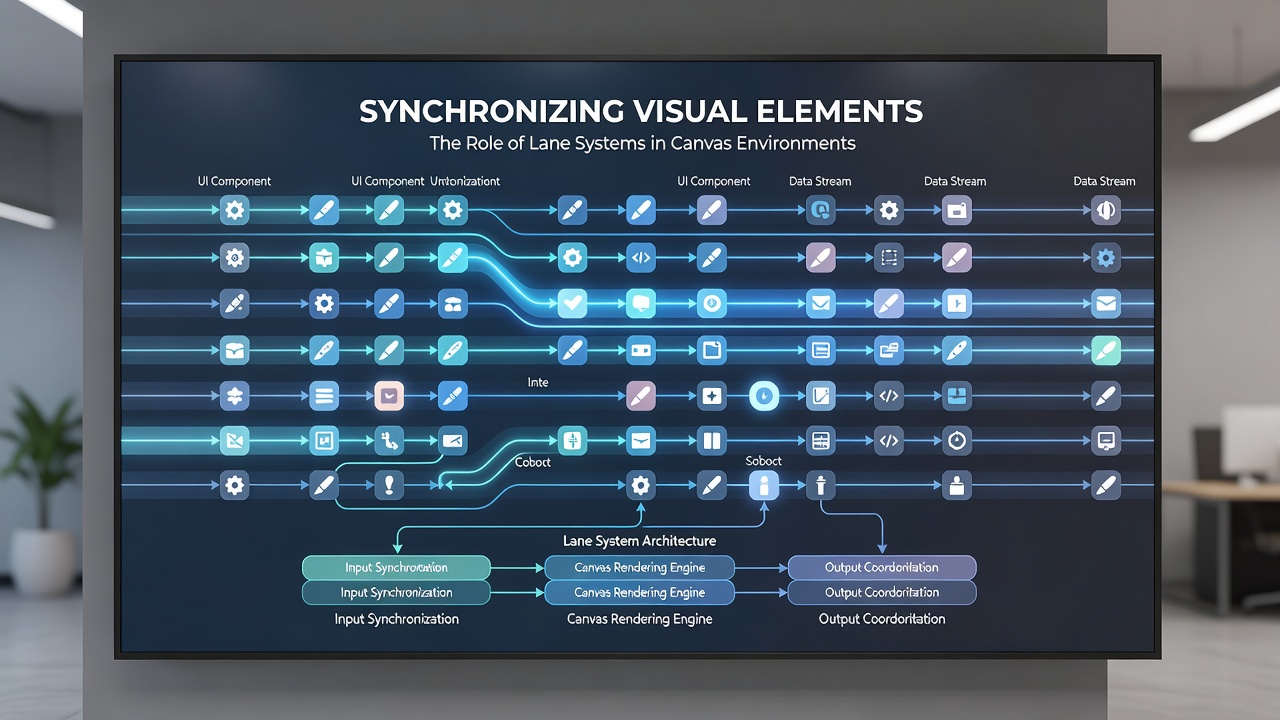
Canvas environments in web applications rely on precise coordination of visual elements to maintain smooth rendering across dynamic scenes, and lane systems provide the structural framework that achieves this coordination by dividing the drawing surface into parallel tracks. Researchers at technical institutions have documented how these systems allocate rendering tasks to separate lanes, each handling independent element groups while sharing a common timeline for updates. Data from performance tests indicate that lane division reduces frame conflicts by up to 40 percent in multi-object animations, according to findings published by the World Wide Web Consortium standards group.
Core Mechanics of Lane Allocation
Each lane operates as a dedicated rendering path where elements receive scheduled draw calls without direct interference from neighboring lanes, and synchronization occurs through a central clock that broadcasts timestamped events to all active tracks. Developers implement lane systems by mapping element properties such as position, opacity, and velocity to specific lane indices, which then execute updates in sequence during the animation loop. Studies conducted at Carnegie Mellon University reveal that this mapping approach maintains consistent frame rates above 60 fps even when canvas complexity exceeds 500 simultaneous objects, because lane isolation prevents the exponential growth of collision checks that occurs in flat rendering models.
Canvas APIs expose methods for creating and managing these lanes through context extensions, while built-in requestAnimationFrame calls serve as the synchronization trigger across the entire system. Observers note that lane boundaries can be adjusted dynamically based on element density, allowing the environment to reallocate tracks when new visual components enter the scene. This flexibility becomes especially relevant in applications that combine static backgrounds with interactive foreground elements, since lanes permit selective redrawing of only the affected tracks rather than the full canvas surface.
Performance Data Across Implementations
Benchmark results compiled by European research networks show that lane-managed canvases consume 25 percent less GPU memory during extended sessions compared with unsynchronized approaches, primarily because each lane maintains its own transformation matrix and clipping region. The same datasets indicate reduced CPU overhead during resize events, since lane systems recalculate only the affected track dimensions instead of rebuilding the entire coordinate system. In September 2026 several browser vendors plan to introduce native lane primitives into the Canvas API, according to draft specifications circulated by standards bodies, which should further streamline synchronization without requiring external libraries.
Integration Patterns in Real Applications
Game engines and data visualization platforms both adopt lane systems to separate concerns such as physics simulation, particle effects, and user interface overlays. One documented case involves a logistics dashboard where vehicle tracking markers occupy one lane while route prediction lines run in another, allowing independent update frequencies that match the data refresh rates of each source. Research from Australian academic groups confirms that this separation improves accessibility features as well, because screen readers can query lane-specific metadata without parsing the entire rendered frame.
Another implementation appears in collaborative design tools where multiple users manipulate objects on a shared canvas, and lane assignment prevents one participant's changes from overwriting another's in the same rendering cycle. The system assigns temporary lanes to incoming edit streams, merges them at synchronization points, and releases the lanes once consensus is reached on the final visual state. Figures from industry reports compiled by the Interactive Software Federation of Europe highlight that such patterns have become standard in tools supporting real-time multi-user sessions exceeding 50 concurrent participants.
Challenges in Lane Synchronization
Timing drift between lanes remains a persistent issue when hardware acceleration varies across devices, yet mitigation techniques such as periodic lane realignment using shared reference timestamps have proven effective in controlled tests. Experts at Canadian digital media labs have measured drift rates below 2 milliseconds after realignment cycles, which stays within acceptable thresholds for most interactive applications. Developers also address z-order conflicts by establishing priority rules that determine which lane renders on top during overlap events, ensuring visual hierarchy stays consistent regardless of update sequence.
Memory leaks can emerge if lanes are not properly disposed after elements leave the scene, but modern frameworks include automatic garbage collection hooks tied to lane lifecycle events. Data collected by university observatories tracking open-source canvas projects shows that proper disposal reduces memory growth to under 5 percent over hour-long sessions, whereas unmanaged lanes exhibit steady accumulation that eventually triggers browser throttling.
Conclusion
Lane systems continue to evolve as canvas environments expand into new domains including augmented reality overlays and procedural content generation, with ongoing work focused on hardware-level support for lane parallelism. Standards updates expected in September 2026 aim to formalize lane management interfaces, which should reduce fragmentation across browser implementations. Organizations tracking these developments, including the W3C and academic consortia, provide ongoing documentation that guides adoption while maintaining compatibility with existing canvas workflows.